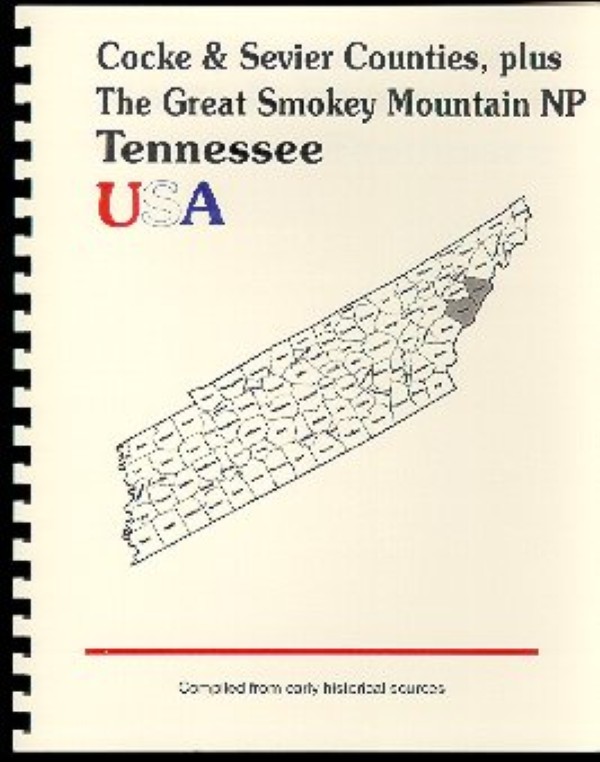
Early days in Cocke & Sevier Counties in East Tennessee, which includes much of the Great Smoky Mountains, are recalled in this spiral bound booklet compiled from excerpts from the 1887 book: History of Tennessee, originally published by Goodspeed Publishing Co., and other sources. The 49-page booklet is printed one-sided on 60# paper with the print enlarged for easier reading. A vinyl sheet has been added to protect the front cover.
The county seats are: Cocke -- Newport; Sevier -- Sevierville. The area includes much of the Great Smoky Mountain National Park and the mountain-tourest towns of Gatlinburg and Pigeon Forge, although they were non-existant or insignificant when most of this material was written.
The first part of the booklet concerns the history of: Cocke County -- Geography (the "Chunky" and "the Irish Bottom"); early settlers -- George McNutt, the Rogers family, John McNabb, Cornelius McGuinn, the Doherty family, the Huffs, Boyers, Ottingers, Peter Fine, John Gilliland, William Lillard, etc.; trouble with Indians, organization of the county, controversy over the county seat location; Names of early officials and early businesses, etc.; and Sevier County -- Geography ; Murder of Boyd and Doggett and other trouble with Indians; Fort on Dumplin Creek; Early settlers -- Maj. Henry, Maj. James Hubbard, Mr. Gist, Capt. James White, Thomas Stockton, Samuel McGaughey, Samuel Newell, John Clark, Isaac Thomas, William Cannon, Jacob Huff, Samuel Blair, the Bryants, the Cates, the Underwoods and many others; Various governments in charge of the territory; First courts; Controversy over the land south of the French Broad and Holston Rivers; Organization of Sevierville, the Nancy Academy, Names of early officials and early businesses; etc.
Besides the names mentioned in the first part of the booklet, there are biographies of many county residents of yesteryear. Most are fairly lengthy, and often include ancestors, previous residences, children, in-laws, affiliations, war records, and business activities. In the course of this they often shed light on the early businesses, professions and institutions in the area. The biographies include: Cocke County -- C.F. Boyer, J.J. Burnett, J.J. Denton, Dr. L.W. Hooper, Capt. A.C. Huff, Col. William Jack, O.M. Kelley, W.W. Langhorne, J.C. La Rue, W.J. McSween, W.F. Morris, Dr. Darius Neas, J.H. Randolph, Dr. A.W. Rhea, Charles Stokely Sr., A.M. Stokely, George W. Susong and W.R. Swagerty; Sevier County -- John W. Andes (with picture), R.H. Andes, William Catlett, John Chandler Jr., J.D. Davis, Dr. J.C. Ellis, J.J. Ellis, J.M. Fagala, William Fowler, Dr. James A. Henderson, A.J. McCallie, M.W. McCown, W.C. Murphy, John Murphy, D.W. Payne, John M. Rambo, J.M. Sharp, Dr. G.E. Sharp, M.P. Thomas, W.H. Wayland Jr., R.E. Whittle, O.M. Whittle, T.D. Wynn, E.M. Wynn and Miller Yett.
Excerpts from Counties of Tennessee by Austin P. Foster, and Tennessee, a Guide to the State, compiled and written by the Federal Writer's Project of the WPA in 1939, are included. The WPA excerpt mentions Shook's Gap, the Battle of Boyd's Creek Monument, organization of the White Caps (similar to the Ku Klux Klan), Pigeon Forge, the Barnes Cherokee Indian Museum, Bear Pen Gap, Newfound Gap, Clingmans Dome, Max Patch Mountain, and the towns of Gatlinburg, Sevierville and Newport.
A special five-page section on the Great Smoky Mountains National Park is included, along with an 8-page section on Tennessee Folklore, both from the WPA book. Here's a brief paragraph from the folklore chapter: Often there is a broad vein of humor in the folk expressions of the people. "I'm so hungry I could eat a bull -- and it bellering!" "He's as lazy as the hound that leaned against the fence to bark." "She's as ugly as a mud fence dabbed over with toad frogs."
|